Strategic Dialogue of Fórum Externo on the impact of the war in the Middle East on Mozambique and the region
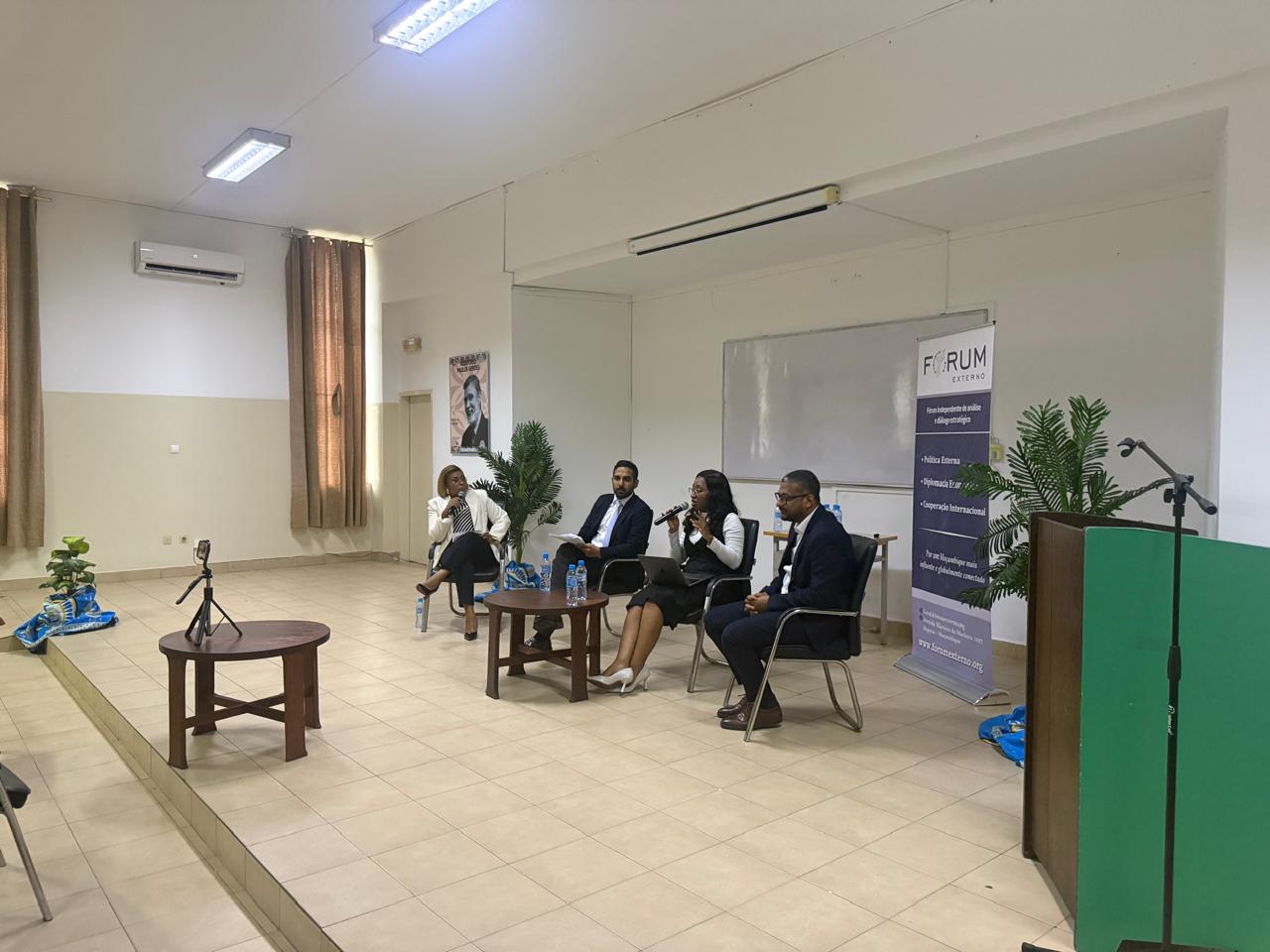
The war between the United States, Israel and Iran falls into both categories — and it was specifically to discuss how the second half of that sentence manifests itself in Mozambique that the Fórum Externo organised, on 28 April at the Pedagogical University of Maputo, the Strategic Dialogue ‘The Impact of the War in the Middle East on Mozambique and the Region’. The panel brought together Riyadh Sidat, from Forum Externo, Fatima Papelo, a lecturer at Joaquim Chissano University, and Irchard Mahomed, in a format of brief presentations followed by a Q&A session. The audience — comprising academics, civil society representatives and development partners — shared a simple assessment: we are far from the theatre of operations, but deeply exposed. And we cannot afford to treat it merely as a foreign policy story.
A conflict that did not begin today — and will not end tomorrow.
The speakers recalled that the tension between the United States and Iran is not new: it dates back to 1979, was exacerbated by the US withdrawal from the JCPOA in 2018, escalated again with the attacks on Iranian nuclear facilities in 2025, and culminated in the US attack on 28 February 2026. What has changed, they argued, is the framework. The post-1945 liberal international order is giving way to a logic of hard power — economic and military power — in which the UN Security Council can no longer mediate and in which even NATO has proved fractured, with Germany, the United Kingdom and Spain refusing to directly support the US operation.
“We are moving towards a more realist international system – and that forces us to think differently about how we position ourselves.”
A strategic pattern has emerged: after Libya and Syria, Iran stands as the last major stronghold before Washington shifts its focus to the Far East and Russia. For Europe, the signal was that it is no longer a US priority — hence the spate of visits to China, in search of energy and trade alternatives.
How the conflict reaches Maputo
In this section, the audience clearly realised just how vulnerable Mozambique is. Around 80 per cent of the fuel consumed in the country comes from the Gulf region. According to a UN report cited during the panel discussion, we are the fourth most dependent country in the world on fertilisers from the Middle East — meaning the conflict extends, unchecked, from the Strait of Hormuz to the Mozambican countryside. At the time of the discussion, Brent crude was already trading above USD 100 per barrel.
But perhaps the most troubling point was another. The crisis of queues at petrol stations, the speakers emphasised, was not one of stock – it was one of perception. The fuel was there. What failed was proactive communication in an era of social media, where misinformation spreads faster than clarification. For a state, this is a political vulnerability every bit as real as economic vulnerability.
Three strategic opportunities
The Dialogue, however, rejected a purely doomsday interpretation. Three opportunities were identified that Mozambique can capitalise on — provided it acts swiftly.
Firstly, Mozambican LNG as a geopolitical asset. In a European and Asian market seeking alternative suppliers to the Strait of Hormuz, gas from Cabo Delgado is now worth more than it was a year ago. Coral Norte, Mozambique LNG and Rovuma LNG are no longer merely economic projects but have become instruments of foreign policy — provided that security in Cabo Delgado and production schedules are consolidated.
Secondly, refining and regional logistics in Africa. Aliko Dangote’s refinery in Nigeria already supplies the continent and even European markets; a new refinery is being planned in Tanzania, with the involvement of the Presidents of Uganda and Kenya. The ports of Lamu and Mombasa have seen their throughput rise from two to 74 ships per quarter. Africa’s energy landscape is being redrawn in real time — and Mozambique is well placed to join this network as a producer, not merely as a consumer.
Thirdly, active economic diplomacy. The speakers favoured pragmatic non-alignment: keeping channels open with the United States, China, Russia, India, the European Union and the Gulf powers, without being subordinate to any bloc. Today, only around 6 per cent of Africa’s foreign trade is with other African countries — a figure that illustrates, better than any speech, the work that remains to be done. Near-shoring, corridor integration, intra-SADC trade: the next global crisis is just around the corner, and the best response begins right next door.
What the External Forum takes away from this Dialogue
The recommendations that remained on the table are demanding but concrete. In the short term: an inter-ministerial task force to monitor external shocks, a boost to the strategic fuel reserve – currently equivalent to just two weeks’ supply – and the professionalisation of crisis communication. In the medium term: diversification of suppliers and energy sources; making better use of Mozambican natural gas, including for domestic use; investment in logistics infrastructure capable of linking Rovuma to Maputo and integrating the Southern, Central and Northern corridors with SADC neighbours; and the formulation of a public foreign policy doctrine for geopolitical crises.
Forum Externo will publish the full Policy Brief.
Our thanks go to the Pedagogical University of Maputo for hosting us, to the speakers who accepted our invitation, and to everyone in the room who asked questions that really matter.
We will continue to translate what is happening far away into decisions that are felt right here at home.
A conflict that did not begin today — and will not end tomorrow.
The speakers recalled that the tension between the United States and Iran is not new: it dates back to 1979, was exacerbated by the US withdrawal from the JCPOA in 2018, escalated again with the attacks on Iranian nuclear facilities in 2025, and culminated in the US attack on 28 February 2026. What has changed, they argued, is the framework. The post-1945 liberal international order is giving way to a logic of hard power — economic and military power — in which the UN Security Council can no longer mediate and in which even NATO has proved fractured, with Germany, the United Kingdom and Spain refusing to directly support the US operation.
“We are moving towards a more realist international system – and that forces us to think differently about how we position ourselves.”
A strategic pattern has emerged: after Libya and Syria, Iran stands as the last major stronghold before Washington shifts its focus to the Far East and Russia. For Europe, the signal was that it is no longer a US priority — hence the spate of visits to China, in search of energy and trade alternatives.
How the conflict reaches Maputo
In this section, the audience clearly realised just how vulnerable Mozambique is. Around 80 per cent of the fuel consumed in the country comes from the Gulf region. According to a UN report cited during the panel discussion, we are the fourth most dependent country in the world on fertilisers from the Middle East — meaning the conflict extends, unchecked, from the Strait of Hormuz to the Mozambican countryside. At the time of the discussion, Brent crude was already trading above USD 100 per barrel.
But perhaps the most troubling point was another. The crisis of queues at petrol stations, the speakers emphasised, was not one of stock – it was one of perception. The fuel was there. What failed was proactive communication in an era of social media, where misinformation spreads faster than clarification. For a state, this is a political vulnerability every bit as real as economic vulnerability.
Three strategic opportunities
The Dialogue, however, rejected a purely doomsday interpretation. Three opportunities were identified that Mozambique can capitalise on — provided it acts swiftly.
Firstly, Mozambican LNG as a geopolitical asset. In a European and Asian market seeking alternative suppliers to the Strait of Hormuz, gas from Cabo Delgado is now worth more than it was a year ago. Coral Norte, Mozambique LNG and Rovuma LNG are no longer merely economic projects but have become instruments of foreign policy — provided that security in Cabo Delgado and production schedules are consolidated.
Secondly, refining and regional logistics in Africa. Aliko Dangote’s refinery in Nigeria already supplies the continent and even European markets; a new refinery is being planned in Tanzania, with the involvement of the Presidents of Uganda and Kenya. The ports of Lamu and Mombasa have seen their throughput rise from two to 74 ships per quarter. Africa’s energy landscape is being redrawn in real time — and Mozambique is well placed to join this network as a producer, not merely as a consumer.
Thirdly, active economic diplomacy. The speakers favoured pragmatic non-alignment: keeping channels open with the United States, China, Russia, India, the European Union and the Gulf powers, without being subordinate to any bloc. Today, only around 6 per cent of Africa’s foreign trade is with other African countries — a figure that illustrates, better than any speech, the work that remains to be done. Near-shoring, corridor integration, intra-SADC trade: the next global crisis is just around the corner, and the best response begins right next door.
What the External Forum takes away from this Dialogue
The recommendations that remained on the table are demanding but concrete. In the short term: an inter-ministerial task force to monitor external shocks, a boost to the strategic fuel reserve – currently equivalent to just two weeks’ supply – and the professionalisation of crisis communication. In the medium term: diversification of suppliers and energy sources; making better use of Mozambican natural gas, including for domestic use; investment in logistics infrastructure capable of linking Rovuma to Maputo and integrating the Southern, Central and Northern corridors with SADC neighbours; and the formulation of a public foreign policy doctrine for geopolitical crises.
Forum Externo will publish the full Policy Brief.
Our thanks go to the Pedagogical University of Maputo for hosting us, to the speakers who accepted our invitation, and to everyone in the room who asked questions that really matter.
We will continue to translate what is happening far away into decisions that are felt right here at home.